
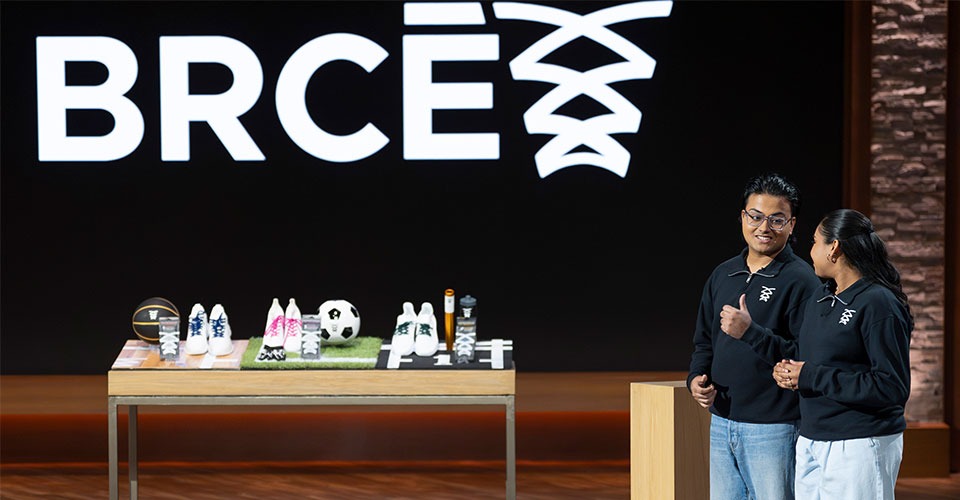
How I Met BRCĒ
I first came across BRCĒ the same way I’ve discovered a lot of impressive student-founded companies: pitch competitions.
After running into Madhav and the BRCĒ team at multiple competitions, it became hard not to pay attention, mostly because they always seem to be beating me. Jokes aside, they kept showing up with a strong company, a polished story, and real traction behind what they were building.
BRCĒ is genuinely one of the most impressive student-founded companies I’ve come across. Seeing them repeatedly in these rooms gave me the chance to get to know the founders, follow the company more closely, and eventually put together this conversation.
Their story is a big part of why I wanted to include founder interviews on Student Founder in the first place. There is a lot to learn from students who are already building real companies, figuring things out as they go, and finding ways to make serious progress while still in school.
From a College Idea to Something Much Bigger
BRCĒ, pronounced “brace,” is a performance materials technology company founded by Michigan State University students Madhav Aggarwal and Tanvi Gadamsetti. Both came from athletic backgrounds, and the company grew around a problem they understood firsthand: athletic equipment does not always perform the way athletes need it to. What began as a simple idea for customizable sneaker laces has since grown into a company with more than $1.6 million in total revenue, patented polymer-composite technology, major pitch competition wins, a nine-person team that includes experienced industry veterans, and a successful appearance on ABC’s Shark Tank.
Its first commercial application was a line of performance shoelaces engineered to resist coming untied during activity, but the company’s ambitions quickly expanded beyond shoelaces into broader performance and safety applications. The traction came almost immediately. According to Madhav, he initially viewed BRCĒ as little more than a small business he could build while in college. There was no complicated R&D process at the beginning, so the goal was simple: get the product in front of customers as quickly as possible.
Within 45 days of forming the LLC, the founders took BRCĒ to SneakerCon Detroit. They sold out in roughly four hours and generated around $6,000 in sales, having launched with only a few hundred dollars of initial seed support.
For the founders, that was the moment BRCĒ stopped feeling like a dorm-room project.
“We knew we were not just a cute dorm room idea anymore.”
Validate Before You Overbuild
One of the most useful parts of BRCĒ’s story is how little happened before they went looking for real customers.
The founders did not wait for a perfect product. They went directly to SneakerCon, stood in front of the exact people they thought might buy from them, pitched the product face-to-face, and sold early versions while they were still imperfect.
Madhav estimates they spent less than $600 to generate their first $6,000 in sales.
For student founders, that is a useful reminder that customer validation does not always need to begin with elaborate research, a finished website, or months of product development. Sometimes the fastest way to understand whether a product has value is simply to put something in front of the customer and see whether they will pay for it.
If Madhav were starting today with an idea but no money, connections, or cofounder, his first move would actually come before building anything.
He would start with Ideal Customer Profile interviews: finding the people who could eventually become customers and learning everything possible about the problem from them.
The point is to understand the problem first, then decide what deserves to be built.
The University Advantage Most Students Ignore
Student founders often think of university entrepreneurship resources as pitch competitions, accelerators, or small grants.
Those helped BRCĒ, but Madhav points to another resource that he thinks is much more overlooked: alumni.
He and the BRCĒ team still spend hours searching LinkedIn for alumni working at companies they want to reach, investment firms they want to understand, and industries where they need expertise.
That network can lead to potential partners, investors, advisors, customers, and introductions that would otherwise be difficult for a student founder to access.
“We can find people in most places: companies we want to partner with, scouts at VC firms, veterans in the industry, through the alumni of our college or university.”
That approach also helped shape the team around BRCĒ. What began with student founders eventually grew into a nine-person organization that, according to Madhav, includes industry veterans with more than 250 years of combined experience.
His formula for getting there was not especially complicated: a lot of LinkedIn requests, constantly asking for help, and being willing to learn from people who knew more than he did.
That represented a major change in how he thought about entrepreneurship.
Early on, he viewed himself as a solopreneur trying to figure everything out alone. Looking back, he considers waiting too long to ask for help one of his biggest early mistakes.
You Don't Have to Be the Most Experienced Person in the Room
Madhav also entered entrepreneurship with an assumption that is probably common among student founders: that successful companies are built by people who have already spent years inside major corporations.
He no longer believes that.
Student founders may lack professional experience, but they can compensate with speed, willingness to learn, and the ability to surround themselves with people who have already done what they are trying to accomplish.
“You can always find smarter people in the rooms you make yourself present in.”
That idea shows up throughout BRCĒ’s growth. Rather than trying to make two college students look like seasoned industry executives, the founders built around their gaps.
It is also something investors look for. Madhav believes a compelling pitch depends heavily on whether investors trust the founders, believe they will persevere, understand the problem, and see evidence that the team is coachable.
A slick deck can help communicate the story, but the founders themselves still have to convince someone that they can learn fast enough to build the company.
When Outside Capital Became Useful
Interestingly, BRCĒ did not begin with the goal of raising venture capital.
The business was generating revenue, and Madhav says the founders were initially happy growing without becoming a traditional VC-backed startup.
Their thinking changed when they realized capital could help them grow much faster.
Outside funding could help them recruit more experienced people, establish stronger processes, invest in R&D, and move faster than a student-run team could by relying entirely on internally generated cash.
That distinction is worth paying attention to. Their decision to raise was not simply, “Startups raise money, so we should raise money.”
It became:
We know what is working. Would additional capital allow us to do substantially more of it, substantially faster?
Eventually that path took BRCĒ all the way to ABC’s Shark Tank.
Madhav Aggarwal and Tanvi Gadamsetti entered the Tank seeking $300,000 for 10% of the company. After negotiations, they accepted a joint offer from Daniel Lubetzky, founder of KIND Snacks, and Fawn Weaver, founder of Uncle Nearest, for $300,000 in exchange for 20% equity. The episode aired March 4, 2026.
By then, what had started as customizable sneaker laces had become a patented materials company with real sales, partnerships, an experienced team, and ambitions extending far beyond its first product.
BRCĒ went on to report more than $1.6M in shoelace sales and take first place at the Rice Business Plan Competition, where the company received $600,000.
What Student Founders Can Take From BRCĒ
The most useful part of this story is probably not that BRCĒ eventually appeared on Shark Tank.
It is everything the founders did before that opportunity existed.
They started with something they could put in front of customers quickly. They sold an imperfect early product instead of waiting indefinitely. They treated their university network as a source of people, not just competitions. They stopped trying to build alone and recruited experience around themselves. And when they eventually pursued outside capital, it was because they had a clearer idea of what that money could accelerate.
A student founder does not need to begin with a perfect product, a giant team, an investor network, or years of industry experience.
BRCĒ certainly did not.
The advantage is being willing to start small, get into the market, learn quickly, ask for help, and continually put yourself in rooms where the next person you meet can change the trajectory of the company.
For BRCĒ, that progression went from a college idea, to a $6,000 afternoon at SneakerCon, to a patented materials company, and eventually to standing in front of the Sharks.