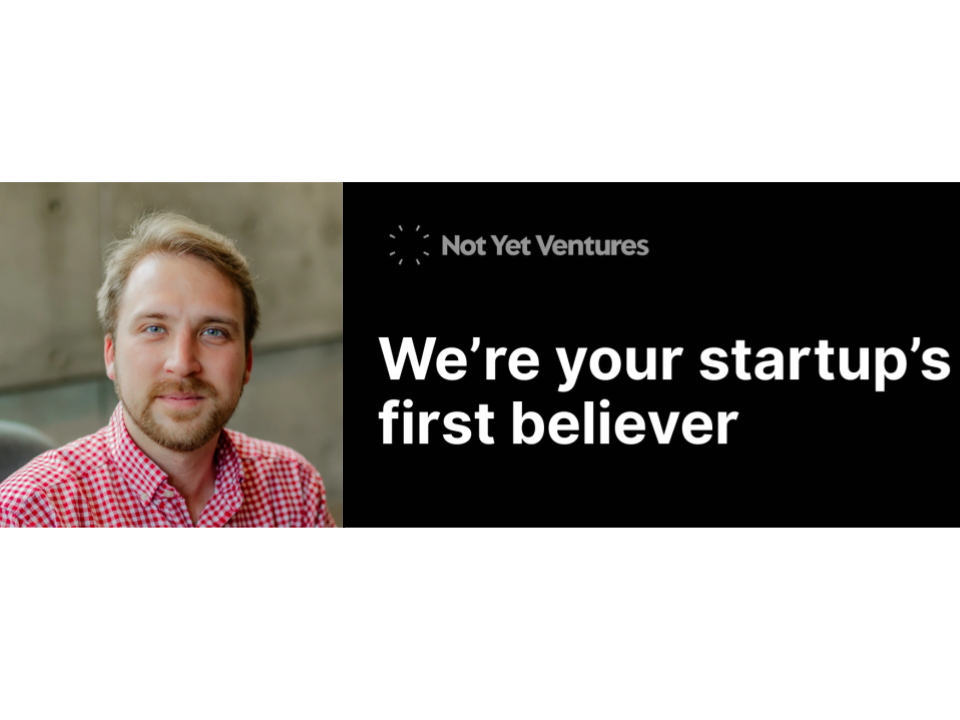
Meet Alex Z and Not Yet Ventures
Alex Z has spent years working with student founders from nearly every side of the table. He has been a student founder himself, coached entrepreneurs, taught entrepreneurship, worked as an AWS scout across hundreds of universities, invested as an angel, and now writes early checks through Not Yet Ventures. That background has given him a particularly close view of what separates founders who simply look promising from the ones who consistently find ways to make progress.
Not Yet Ventures is built around finding founders before they look obvious to everyone else. Rather than waiting for a company to have the perfect résumé, polished pitch, significant traction, or all the signals a traditional early-stage investor might want to see, Alex is interested in identifying the underlying behaviors that suggest a founder can eventually get there. Even when the firm is not ready to invest, the idea behind “Not Yet” is that the conversation does not necessarily end; founders can receive feedback, stay on the firm’s radar, continue sending updates, and reopen the conversation as the facts change.
That philosophy is especially interesting for student founders. Students often assume they are starting at a disadvantage because they lack years of industry experience, previous exits, or a traditional professional track record. Alex sees it differently. In some ways, he believes being a student makes entrepreneurial behavior easier to evaluate because students are already building under obvious constraints: limited time, limited capital, smaller networks, and the demands of a full course load. If someone is still finding ways to build, test, learn, and make progress under those conditions, that can tell an investor something meaningful about how they operate.
I asked Alex six questions about what he looks for in student founders, what creates credibility with investors, how he thinks about traction before revenue, and the mistakes that can make a founder look less investable than they actually are.
1. When you evaluate a student founder, what qualities do you need to see that you might not require as strongly from a more experienced founder?
I actually think the distinction between student founders and more experienced founders is a bit of a false one. I do not evaluate student founders by a completely different standard. The qualities that matter to me are the same at any age: consistency, ownership of mistakes, genuine curiosity, and being proactive. Those traits are rare no matter how old someone is.
If anything, the student environment can make those qualities easier for me to see. A student founder is usually working with obvious constraints. They have classes, limited time, limited money, and a smaller professional network. When someone is still finding ways to make meaningful progress despite those constraints, that tells me something real about their initiative and resourcefulness.
The one thing I genuinely waive for students is résumé. I do not need years of domain expertise, previous exits, or a long professional track record. What I need is evidence that this person can run learning loops on their own and keep moving without someone else pushing them. The signal I care about most is behavioral, not biographical.
2. Because student founders usually have less professional experience, what signals make you believe they can still execute at a high level?
One of the strongest signals I look for is what happens between meetings. A polished pitch, a strong deck, or one good conversation is relatively weak evidence. What someone actually does in the two or three weeks after we talk is much more revealing.
I tend to see three patterns. The first is the founder who leaves a meeting energized but does very little afterward. They come back with essentially the same deck, the same problems, and some explanation for why they were busy. The second founder makes progress, but only when an external force is pushing them. They move because of a competition, professor, accelerator, grant, or investor, then stall when they need someone else’s permission.
The third founder keeps moving. They take the introduction, test the suggestion, talk to users, run the experiment, and if something does not work, they come back with what they learned and what they are going to try next. I was not the engine. They were. That internally motivated, proactive pattern is consistently the one I fund.
I also pay a lot of attention to updates. The best founder updates read almost like scientific lab notes: I tried A expecting B, got C instead, learned D, and now I am doing E expecting F. The update does not need to make everything look good. In fact, failures can make someone more credible when they explain what they tried, what happened, and what changed because of it. Anyone can get lucky once. What I am looking for is a founder who has built a process that repeatedly creates learning and progress.
3. How important is self-awareness for a student founder, specifically knowing what they don't know and surrounding themselves with experienced advisors or team members?
Self-awareness matters enormously to me, but simply having advisors does not.
I am actually skeptical when an early founder leads with, “We have great advisors,” as one of the main reasons I should take the company seriously. The existence of impressive names on a slide does not tell me very much. What matters is what those relationships have actually helped the company accomplish.
Did that advisor help unlock a customer? Did they help you run a better experiment? Did they create an important introduction? Did their involvement materially change your product or your strategy? That is useful. Collecting advisor titles because they make the deck look stronger is not.
I also think founders have to be careful not to use advisors as a substitute for learning something themselves. Saying, “We do not understand marketing, so we brought on a CMO advisor,” is less compelling to me than saying, “We realized we did not understand marketing, so we ran several experiments, learned what worked, and changed our approach.” Filling gaps by finding things out is founder behavior. At this stage, that is what I am trying to identify.
4. What separates a student founder who comes across as genuinely credible from one who simply has an interesting idea?
Credibility is not really about the idea for me. Ideas are one of the least important things I evaluate at the earliest stage. At Not Yet, we weight the team and the founder’s ability to move quickly much more heavily because we assume the original idea is going to change in some meaningful way.
What I am really underwriting is what survives that change: the people and how quickly they can learn.
The founders who come across as credible tend to show the same four qualities I mentioned earlier: consistency, ownership of mistakes, genuine curiosity, and proactivity. They repeatedly do what they said they would do. They bring bad news instead of hiding it. They are actually curious about the problem, rather than performing curiosity for the pitch, and they continue moving without waiting for someone else to push them.
There are also things that quietly hurt credibility. One is using adjectives without numbers. “Huge market,” “incredible traction,” or “massive opportunity” tells me very little by itself. Another is polish theater: a beautiful deck hiding a product that has barely been built or tested. I would much rather hear one simple sentence like, “Eleven students used it every day last week,” than see ten slides describing your “incredible early traction.” Concrete evidence is much more forwardable and much more believable.
5. Do you evaluate traction differently for student founders? Can customer discovery, technical progress, partnerships, or non-dilutive funding compensate for a lack of revenue?
Traction is valuable, but to me it is a lagging indicator of a system that is working. The deeper question is whether the founder has the operating process and mindset that produced the traction in the first place.
Revenue, customer growth, partnerships, grants, technical milestones, and other KPIs can all matter, but they are still outputs. I want to know what behaviors produced those outputs and whether those behaviors are repeatable.
The danger is that founders can confuse activity with progress. You can spend all of your time winning competitions, attending events, speaking on panels, posting on social media, applying to programs, and polishing materials. That can make you feel extremely busy while producing almost no evidence that the actual business works. I think of that as theater.
Customer discovery is real if you talk to twenty customers and then change something because of what they told you. Technical progress is real if it resolves an important uncertainty. A grant is useful if you use the money to run the experiment you said you needed to run. A partnership matters if it actually produces a user, customer, pilot, or meaningful learning. If it just sits on the deck as a logo, it is not doing very much for me.
I would rather see modest but measurable customer growth paired with consistent communication and a clear learning process than a highly polished deck covered in grants and partnership logos.
6. What is the biggest mistake student founders make when trying to convince investors they are ready to build a serious company?
The biggest mistake is waiting for permission.
You hear it in sentences that begin with “in order to.” In order to build it, I need a technical cofounder. In order to raise, I need a lead investor. In order to be taken seriously, I need to get into an accelerator. In order to launch, the product needs to be perfect.
Every one of those creates a condition where someone or something else controls whether you can keep moving.
The question I want founders to ask instead is: What can I do next with what I already have? What can I do with my current skills, my existing network, and the resources available to me this week? That orientation creates action, action creates evidence, and evidence is ultimately what creates conviction for an investor.
The second biggest mistake is not communicating. Going dark is worse than sending a bad update. I would much rather get a short note every month explaining what you tried, what happened, and what you learned than have you disappear and come back months later with a new deck.
A close third is trying too hard to look ready instead of being honest about where you are. I do not need you to be ready. The firm is literally called Not Yet. I want to meet people before they look impressive to everyone else, because my job is to identify the initial spark and the trend that suggests someone could become that kind of founder.
The Biggest Takeaways
The strongest theme across the conversation is that student founders do not need to manufacture the résumé of a much more experienced entrepreneur. What matters more is whether they can repeatedly learn, execute, communicate, and take initiative. A strong pitch may get an investor’s attention, but what happens between meetings is often what builds real conviction.
The same principle applies to traction, advisors, grants, partnerships, and competitions. None of those things are automatically valuable simply because they appear on a slide. Their value comes from what they help the founder learn, prove, or accomplish. The founder who talks to customers and changes the product, uses a grant to answer a critical technical question, or turns an advisor relationship into a meaningful outcome is showing something much more important than surface-level credibility.
Perhaps the most useful idea from the conversation is also the simplest: stop waiting for permission. Student founders are almost guaranteed to have less money, experience, time, and access than they would like. The question is not whether those constraints exist. It is whether you can keep finding a useful next step with the resources already in front of you.
Want to Pitch Not Yet Ventures?
Not Yet Ventures intentionally wants to meet founders early. Alex emphasized that founders should not assume they need to wait until they are raising, polished, or obviously investable before reaching out. If the timing is not right for an investment, a founder can still enter the firm’s radar and use ongoing updates to show how both the company and founder are progressing.
If Not Yet passes initially, Alex says founders receive written feedback and a potential path back into the conversation as the facts change. The idea behind the firm’s name is quite literal: sometimes the answer is not “no,” it is “not yet.”
If you are building something and are unsure whether you are ready, Alex specifically encourages founders to reach out:
Pitch Not Yet Ventures: https://notyet.vc/pitch